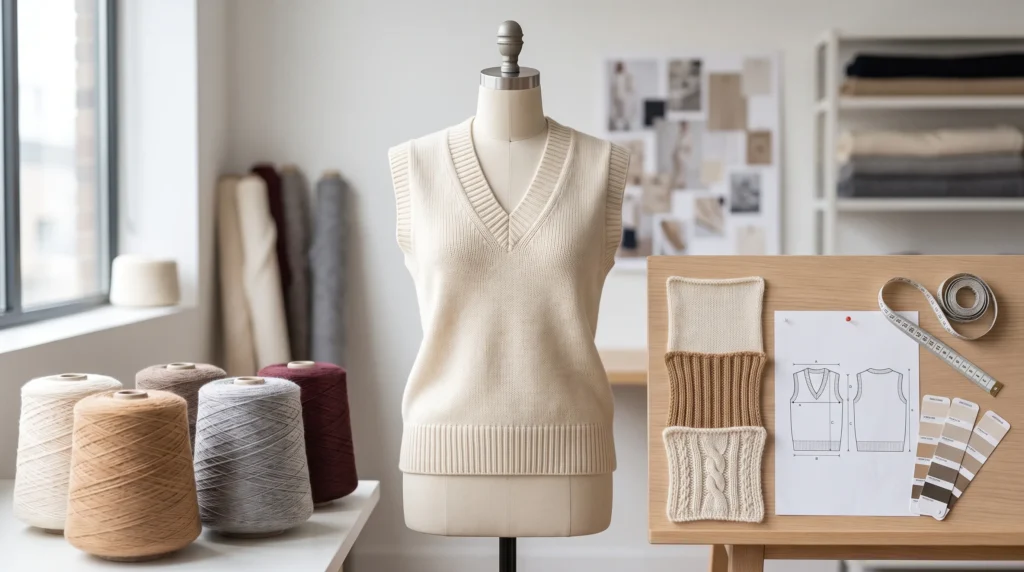
Women’s Sweater Vest Guide: Yarn, Fabric, Knit Structure, Fit & Product Development
A women’s sweater vest may look like a relatively simple sleeveless layer, but developing one for a commercial collection involves several connected decisions. Yarn composition, knit structure, gauge, neckline construction, armhole shape and fit all influence how the finished garment looks, feels and performs.
For fashion brands, retailers, wholesalers, importers and private-label buyers, choosing an attractive design is only the beginning. The product must also suit the target customer, season, price position, layering requirements and expected care conditions.
Buyers planning a coordinated range can explore the main guide to the types of women’s tops to understand how knitted vests differ from T-shirts, polo shirts, woven blouses and structured woven vests.
This guide explains how buyers can approach women’s sweater vest development—from selecting yarn and knit structure to reviewing fit, samples and finished-product quality.
What Makes a Women’s Sweater Vest Different?
A sweater vest is generally a sleeveless knitted garment designed for layering or wearing as a standalone top. “Sweater vest” and “knitted vest” are often used interchangeably, although terminology can differ between markets.
Unlike a basic cut-and-sew T-shirt, sweater-vest development may begin with yarn rather than a finished fabric roll. The chosen yarn, machine gauge, stitch construction and shaping method work together to create the garment’s surface, weight, stretch and silhouette.
A knitted vest can be:
- Fitted or body-skimming
- Cropped
- Boxy
- Relaxed
- Oversized
- Longline
- Designed specifically for layering
It may include a V-neck, crew neck, cable design, jacquard pattern, contrast ribs or a clean minimal surface. The intended product must therefore be clearly defined before technical development begins.
Choosing the Best Yarn for a Sweater Vest
There is no universally best yarn for a sweater vest. The appropriate choice depends on the intended season, target market, desired hand feel, garment appearance, care expectations and commercial position.
Yarn should not be approved based only on a small colour card. Buyers should evaluate how it behaves when knitted in the proposed gauge and structure.
Important yarn-selection criteria include:
- Fibre composition
- Yarn count or thickness
- Ply and construction
- Twist and evenness
- Softness and hand feel
- Drape
- Warmth
- Breathability
- Recovery
- Pilling tendency
- Care requirements
- Colour consistency
Cotton and cotton-blend yarns
Cotton can be considered for lightweight, transitional or warm-weather sweater vests. It can create a familiar hand feel and work well for casual, minimal or clean-surface designs.
However, the word “cotton” alone is not a complete specification. Yarn quality, knit density, structure and finishing can all change the appearance and performance of the garment.
Cotton may also be blended with other fibres to adjust softness, recovery, drape, durability or care performance. Buyers should review the actual blend ratio and knitted sample rather than judging suitability from the fibre name alone.
For buyers comparing sweater-vest materials with cut-and-sew knits, the T-shirt fabric guide explains how fibre, knit construction, weight and fit work together in women’s apparel.
Wool and wool-blend yarns
Wool and wool blends may suit cold-weather, premium or natural-texture collections. Fine wool yarns can create refined surfaces, while heavier yarns may support more substantial and textured products.
Buyers should assess:
- Fibre fineness
- Softness against the skin
- Warmth
- Surface appearance
- Shape recovery
- Pilling expectations
- Required care method
Not all wool yarns provide the same result. The exact fibre, yarn construction, finishing and care requirements should be confirmed in the product specification.
Acrylic and synthetic yarns
Acrylic and other synthetic fibres may be used when the product requires particular colour, bulk, durability, care or commercial characteristics.
Their suitability depends on fibre quality, yarn construction, blend ratio and intended knit. Buyers should review softness, static, recovery, surface appearance and pilling performance instead of assuming that all acrylic yarns behave alike.
Viscose and soft-handle blends
Viscose-containing yarns may help produce a softer hand feel and more fluid drape. These qualities can suit refined or fashion-led silhouettes, but recovery and dimensional stability should be evaluated against the intended fit.
Blended sweater vest yarn can combine useful characteristics from multiple fibres. However, a blend should be assessed as a complete material—not simply as a list of fibre percentages.
Approve a knitted swatch, not only the yarn
A yarn cone cannot show exactly how the finished garment will behave. Buyers should request swatches developed in the proposed:
- Yarn
- Colour
- Gauge
- Stitch structure
- Density
- Finishing direction
This makes it easier to compare texture, weight, stretch, recovery and design definition before developing the complete garment.
Sweater Vest Fabric, Material and Knit Structure
The phrases sweater vest fabric and sweater vest material are often used broadly, but they do not always describe the same thing.
Fibre is processed into yarn. Yarn is then knitted into a particular structure. The combination of fibre, yarn and knitted construction creates the material used in the finished vest.
A complete sweater-vest specification should therefore identify more than fibre content.
| Knit direction | Typical visual effect | Buyer considerations |
| Plain or jersey-style knit | Clean, relatively smooth surface | Density, stability, finishing and edge control |
| Rib structure | Stretch, texture and recovery | Rib width, tension and shape retention |
| Cable knit | Raised, dimensional texture | Pattern definition, weight and consistency |
| Jacquard knit | Integrated colours or patterns | Artwork scale, colour control and reverse appearance |
| Pointelle or openwork | Lightweight decorative surface | Openness, snagging and layering requirements |
The same yarn can produce visibly different results when the structure changes. Cable patterns can add texture and visual volume, while plain constructions may create a cleaner surface. Ribbing can provide stretch and stability, but it must have sufficient recovery for the intended neckline, armholes and hem.
How Gauge Influences a Knitted Vest
Gauge should be evaluated together with yarn count and knit structure.
A finer-gauge construction can create a smoother, lighter and more refined appearance. A lower-gauge construction generally accommodates coarser yarns and more visible texture.
Neither direction is automatically better. The correct gauge depends on:
- Yarn thickness
- Fibre composition
- Stitch structure
- Desired density
- Garment weight
- Pattern complexity
- Target season
- Intended silhouette
- Required surface appearance
Buyers should avoid copying a gauge from an unrelated garment. A successful combination must support the specific design and approved yarn.
Developing the Right Women’s Sweater Vest Fit
Fit should be developed around how the garment will be worn. A vest intended for layering over a blouse requires different ease and armhole proportions from one designed as a standalone sleeveless top.
The intended silhouette should be communicated through technical sketches, measurement charts and reference garments—not only descriptions such as “regular” or “oversized.”
Important measurement areas include:
- Shoulder width
- Chest width and body ease
- Armhole depth and shape
- Neck width and depth
- Front and back body length
- Hem width
- Side-seam shape
- Rib depth and recovery
Armholes require particular attention. If they are too shallow, the base garment may bunch or restrict movement. If they are too wide or deep, the vest may expose more of the underlayer than intended and lose its planned silhouette.
Length must also suit the design. A cropped vest may require stable hem construction, while a relaxed or longline style needs careful control of width, weight and drape.
Test the fit with the intended base layer
A common development mistake is fitting the vest over a thin top when the final product is intended to be worn over a structured shirt or blouse.
The likely underlayer should be identified at the beginning of development. Buyers can use the blouse fabric guide to understand how blouse weight, drape and structure may influence a layered outfit.
Fit reviews should then evaluate armhole clearance, shoulder placement, movement and visual balance under realistic wearing conditions.
Necklines, Ribs and Design Details
V-neck and crew-neck constructions can both work for a women’s sweater vest, but they create different technical considerations.
The neckline should retain its intended shape without looking stretched, uneven or distorted. Rib depth, tension, linking and recovery all influence the result. Similar checks apply to armhole and hem ribs.
Possible design details include:
- Contrast neck and armhole trims
- Stripes
- Cable patterns
- Jacquard artwork
- Pointelle structures
- Colour blocking
- Embroidery
- Branded labels
- Decorative buttons or plackets
Artwork should be evaluated at actual garment scale. A motif that appears balanced in a digital design can change when translated into knitted stitches or graded across sizes.
Brands developing several women’s top categories can review the women’s tops collection before deciding how sweater vests should coordinate with T-shirts, polos and woven styles.
Women’s Sweater Vest Product-Development Process
A structured development process reduces interpretation and gives buyers a clearer basis for reviewing samples.
1. Define the commercial purpose
Clarify the intended customer, selling season, end use, price position and role of the vest within the collection.
2. Prepare a detailed technical brief
The brief should include:
- Design drawings
- Complete measurements
- Fit references
- Yarn composition and specification
- Colour information
- Knit structure
- Gauge direction
- Neckline, armhole and hem details
- Trims and labels
- Artwork placement
- Testing expectations
- Packaging instructions where applicable
3. Review yarn and knitted swatches
Swatches allow buyers to assess colour, softness, density, texture, pattern definition and recovery before reviewing the whole garment.
4. Evaluate the development sample
Check the silhouette, proportions, measurements, neckline, armholes, hem, stitch consistency and overall surface quality. Sample comments should be specific and measurable.
5. Conduct a realistic fit review
Use the intended base layer and record all corrections. Comments such as “make it fit better” are too subjective; identify the exact measurement or construction area that requires adjustment.
6. Establish an approved reference
Once accepted, the approved sample, measurement specification, yarn and confirmed construction should become the reference for future evaluation.
For a broader view of apparel planning, supplier communication and sampling, buyers can review the fashion sourcing guide for women’s clothing brands.
Buyer Quality Checks for a Knitted Vest
Quality should be assessed against an approved product specification. A vest should not be accepted solely because it feels soft, heavy or visually attractive.
Important checks include:
- Correct yarn composition
- Approved colour and shade consistency
- Even stitch appearance
- Correct knit pattern
- Symmetrical neckline and armholes
- Secure linking, seams and joins
- Accurate finished measurements
- Rib stretch and recovery
- Correct artwork placement
- Absence of holes or dropped stitches
- No loose yarns or visible defects
- Acceptable pilling and snagging performance
- Dimensional stability after the agreed care process
- Colourfastness under relevant conditions
- Correct labels, trims and packaging
Testing methods and acceptance limits should be agreed according to the material, construction, intended use and destination-market requirements. Universal tolerances should not be assumed.
Common Sweater-Vest Development Mistakes
Several preventable mistakes can weaken the final product:
- Selecting yarn without reviewing a knitted swatch
- Copying gauge from an unrelated garment
- Failing to identify the intended base layer
- Approving artwork without checking knitted scale
- Ignoring armhole shape or rib recovery
- Using unclear fit comments
- Changing yarn, structure or measurements without reviewing their combined effect
- Comparing quotations based on different product specifications
A clearly documented product brief helps reduce these risks and provides a consistent reference throughout development.
Buyer Checklist Before Approving Development
Before requesting or approving a women’s sweater vest sample, confirm:
- Target customer and intended season
- Fibre composition and yarn specification
- Approved colour standard
- Knit structure and gauge direction
- Silhouette and layering requirements
- Complete measurement chart
- Neckline and armhole construction
- Hem and rib specifications
- Artwork, trims and branding
- Testing and care expectations
- Approved reference swatch or sample
- Packaging and labelling requirements
Frequently Asked Questions
What is the best material for a women’s sweater vest?
There is no universally best sweater vest material. Cotton, wool, acrylic, viscose and blended yarns can support different product requirements. The correct choice depends on season, warmth, hand feel, drape, care expectations, price position and knit structure.
What is the best yarn for a sweater vest?
The best yarn is one that produces the required appearance and performance in the selected gauge and structure. Buyers should evaluate composition, yarn count, ply, twist, evenness, softness, recovery and behaviour after care.
What is the difference between a sweater vest and a knitted vest?
The terms often refer to the same sleeveless knitted garment. “Sweater vest” is common in consumer and fashion language, while “knitted vest” may appear in sourcing and product-category descriptions. Terminology can vary by market.
How does gauge affect a sweater vest?
Gauge works with yarn thickness and stitch structure to influence density, texture, weight and surface appearance. It should be selected according to the design instead of being treated as an independent indicator of quality.
How should a women’s sweater vest fit for layering?
A layering vest needs sufficient room around the chest, shoulders and armholes for the intended base garment. It should be fitted over a realistic blouse, shirt or top during sample review.
What should buyers check in a knitted-vest sample?
Buyers should check the yarn, colour, measurements, silhouette, neckline, armholes, rib recovery, stitch consistency, pattern placement, linking quality and performance after the agreed care and testing procedures.
Build a Better Women’s Sweater Vest Product
Successful women’s sweater vest development depends on coordinated decisions. Yarn, knit structure, gauge, fit, layering requirements and finishing must work together to support the intended design and customer.
A detailed technical brief, relevant knitted swatches, realistic fit reviews and measurable quality expectations give buyers a stronger foundation for product approval.
Fashion brands and apparel buyers can explore Asia Sourcing Limited’s women’s knitted vest collection and contact Asia Sourcing Limited with their design references, specifications and sourcing requirements.